How Many IVF Cycles Are Needed to Get Pregnant
Ask this question early in the process and you’ll hear a range of answers because there isn’t one number. Some patients get pregnant on their very first cycle. Others need two, three, sometimes more. That’s not an evasive answer. It is just how many IVF cycles are needed to get pregnant depends on several factors.
What Affects IVF Success
A few overlapping factors affect the whole process. Let’s see what those are!
1.Age
Age drives outcomes more than any other factor. As women get older, egg quantity and quality decline. That affects fertilization, embryo development, and the risk of chromosomal abnormalities. That’s why success rates run higher in younger patients.
2.Ovarian Reserve
Ovarian reserve is how many eggs remain. AMH tests and antral follicle counts help doctors estimate it and predict how the ovaries will respond to stimulation. A lower reserve doesn’t rule out IVF working. It just usually means fewer eggs retrieved.
3.Sperm Quality/ Quality of Eggs
Sperm concentration, motility and shape affect fertilization and embryo development. When quality is an issue, ICSI, injecting a selected single sperm into the egg can help.
4.Embryo Quality
Not every embryo develops the same way after fertilization. The number and quality available at the time of transfer does affect the outcomes of pregnancy.
5.Cause of Infertility
Blocked tubes, endometriosis, ovulation disorders, male-factor infertility, unexplained infertility, each are different and so is the treatment.
Is One IVF Cycle Enough
Some patients do get pregnant on their first IVF cycle. It happens and it’s wonderful when it does. But, not everyone gets a successful outcome on the first IVF cycle. Some patients need two or three attempts before it works, and that’s not unusual. A lot depends on the genetic and chromosomal quality of the oocytes (eggs) and sperm, how fertilization goes and whether the resulting embryo develops normally into a viable embryo. The endometrial lining matters too (its thickness, pattern, texture, and blood flow) all affect how receptive it is to implantation.
A Real-World Example
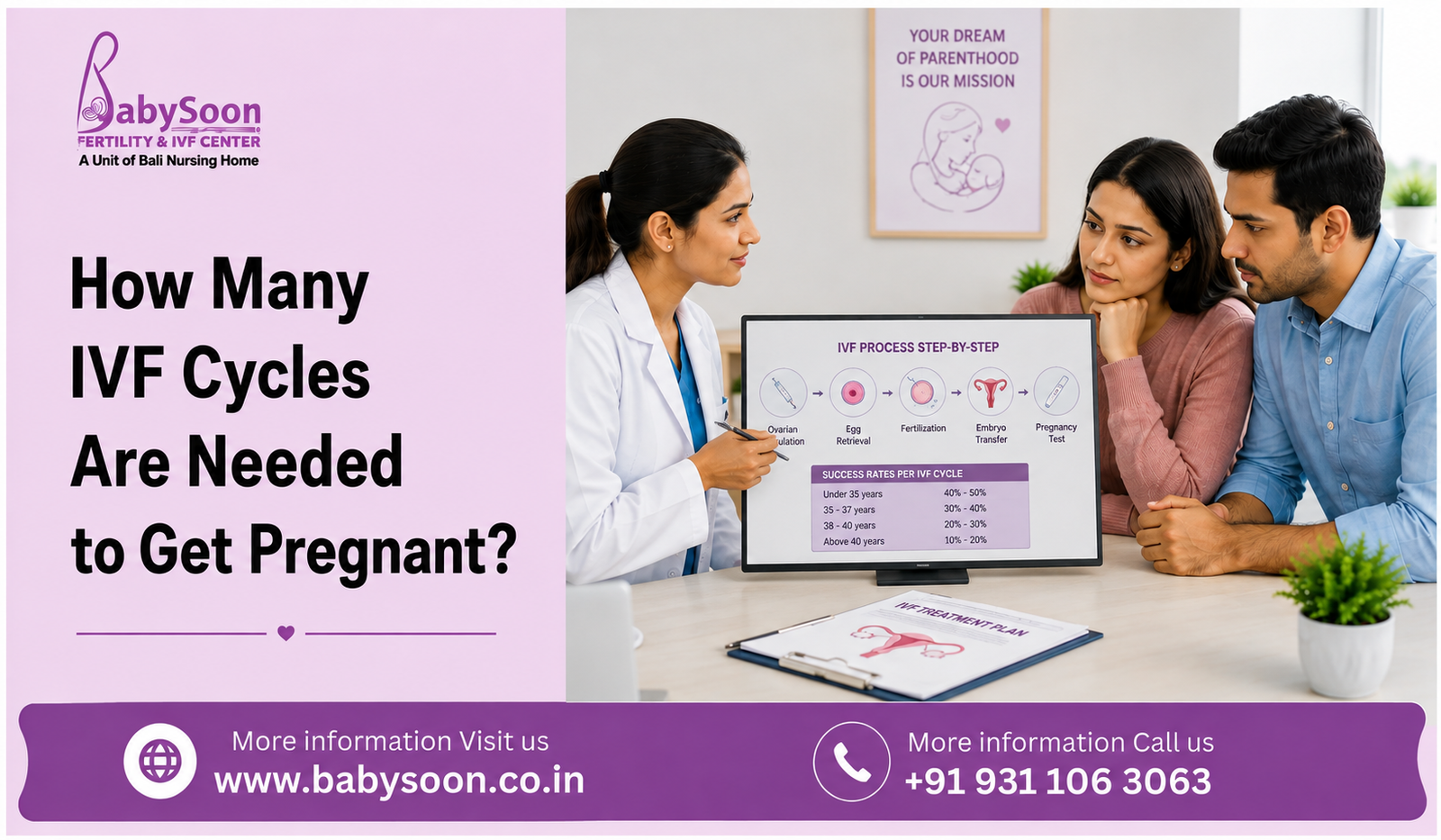
Globally, IVF success rates run about 50-60% per embryo transfer. But that figure can look very different in practice, even between two women the same age.
Take two 28-year-olds going through IVF treatment in Delhi. The first retrieves 12 eggs, which develop into 8 embryos, giving her four separate opportunities to transfer, each carrying that same 50-60% chance of pregnancy.
The second retrieves only 5 eggs and ends up with 2 good-grade embryos, indicating only one real shot at conception and if that transfer doesn’t succeed, she may need to go through additional retrieval attempts.
Note: IVF success rate isn’t fixed, it varies from cycle to cycle, depending on all the factors mentioned above.
What Happens If the First IVF Cycle Fails
One failed cycle doesn’t mean IVF won’t work for you. Most fertility teams go back through what happened before moving forward with another try. Depending on the case, the doctor may look at:
- Response to ovarian stimulation
- Number of eggs retrieved
- Fertilization rate
- Embryo development
- Endometrial lining
- Details of the embryo transfer
- Whether any embryos are still frozen
- Age and ovarian reserve
- Other fertility factors already on record
Can You Improve Your Chances of IVF Success
There’s no guarantee with IVF, no clinic can promise a result. But sticking closely to your specialist’s treatment plan and tackling the fertility factors that are actually within your control can support the process. How many IVF cycles are needed to get pregnant still varies from person to person.
Your doctor may ask you to:
- Attend recommended consultations and tests
- Take prescribed medications exactly as instructed
- Avoid smoking and recreational drugs
- Eat a balanced, nutritious diet
- Work toward a healthy weight, where appropriate
- Keep any existing health conditions managed under medical guidance
- Follow pre-procedure instructions closely
PRE- ART is a must
Before starting the IVF treatment, PRE-ART evaluation and treatment is very important. IVF happens to run better when you don’t skip the groundwork. Your fertility specialist will want a clear picture of where things stand, overall health, reproductive history, ovarian reserve, sperm quality and anything else that might complicate things. Identifying and managing relevant factors before ART helps to build the treatment plan around your specific situation.
Also PRE-ART treatment goes a long way. PRE-ART involves a set of medications and minerals that helps in overall IVF treatment, conception and pregnancy such as:
-
- Folic Acid: Prevents neural tube defects in baby
- Calcium: Supports bone health & essential functions during pre-conception
- Vitamin D3: Supports reproductive health & immune function
- Vitamin B12: Supports red blood cell formation, nerve health & normal cell development
- Coenzymes: Supports cellular energy production & overall reproductive health
- Vaginal Pessary: To cure any local vaginal infections
Along with PRE ART Medications Routine, blood investigations also play an important role in IVF/ Conception/ Pregnancy, such as:
1.CBC with PS: To diagnose anemia, infections , inflammation in the body so that they can be treated beforehand.
- Viral Markers: To rule out any kind of viral infection. Such as HIV, HbsAg, HCV, VDRL in the body. If any of this comes positive the treatment plan changes accordingly.
- HbA1C/Blood Sugar: To rule out diabetes mellitus. If sugar levels are high, the treatment starts after managing the sugar levels.
- LFT/KFT: To rule out kidney & liver health.
- Hb Electrophoresis: To rule out thalassemia in patients. If one partner comes out to be thalassemia minor, it’s important to check the other. So that the baby is not born with thalassemia major disorder which is a serious health hazard.
- Rubella IgG/IgM: To check if the patient is immune to rubella. If not, the patient is given rubella vaccine before starting the treatment, as rubella is a major cause of miscarriages in pregnancy.
- Serum Prolactin Level: To check prolactin level because higher levels cause delayed or no ovulation & lower egg quality.
- AMH: To check ovarian reserve. It is one of the most important tests because the whole treatment plan depends on egg reserve.
| For PCOS | For Poor Responder (AMM <1) |
|
|
Understanding IVF Expectations
There’s no single number that answers how many IVF cycles are needed to get pregnant. Some people conceive on their first transfer while others need two, three, or more rounds. Age, fertility history, ovarian reserve, sperm factors and how your body responds to the process, all of these play a huge role. Your fertility specialist is better placed to guide you what to expect for your specific case, including what comes next if the first attempt doesn’t succeed.
Wondering what your own path might look like? At Baby Soon, our fertility specialists review your history and test results before giving you any advice. Book a consultation with our team today!