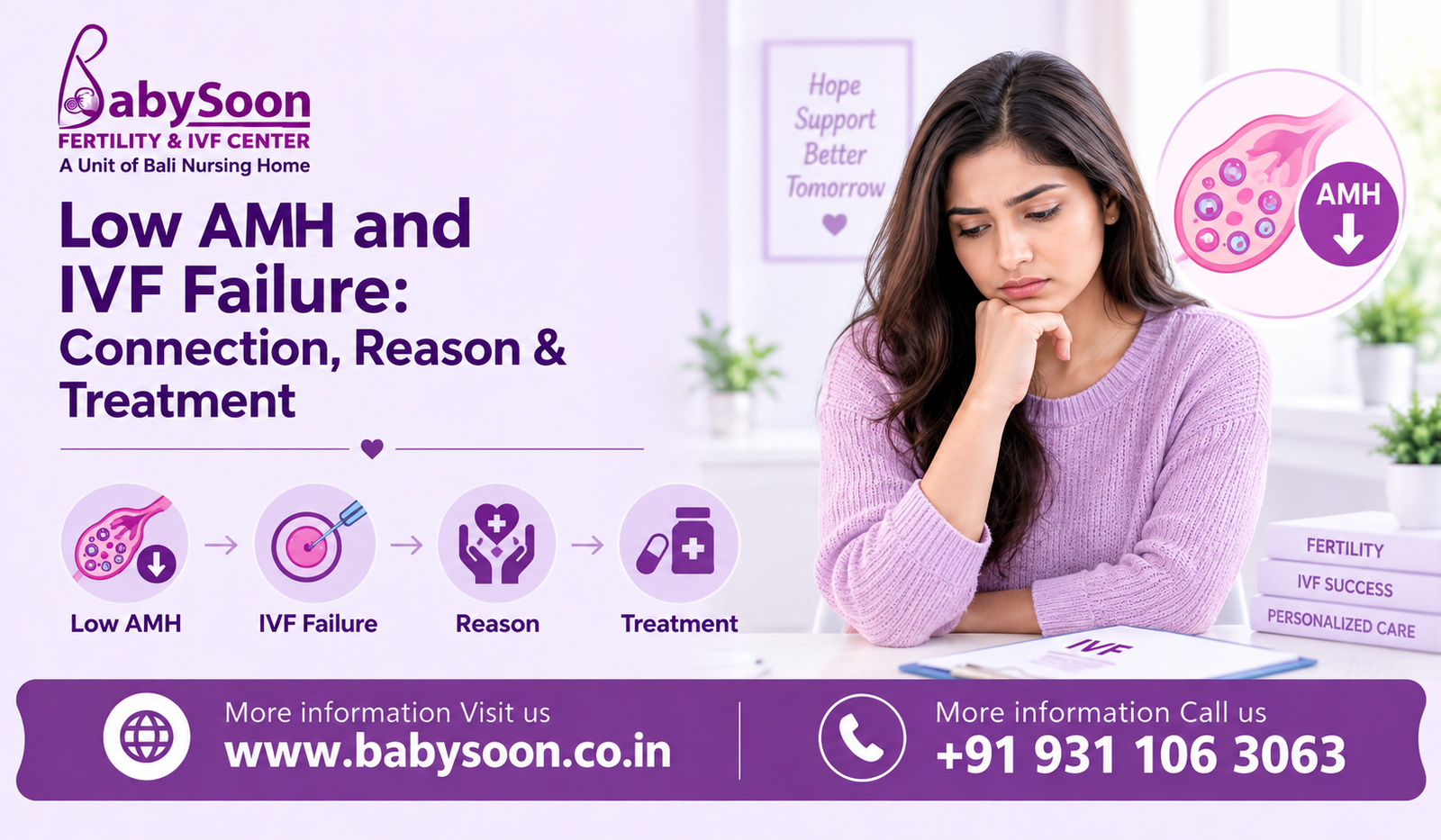
Low AMH and IVF Failure: Connection, Reason & Treatment
Being told that you have low AMH after an unsuccessful IVF cycle can be worrying. Many women immediately wonder, “Did low AMH cause my IVF failure?” or “Can I still become pregnant with a low AMH level?”
The answer is not as simple as looking at one blood test. AMH, or Anti-Müllerian Hormone, is primarily used to assess ovarian reserve and help doctors understand how the ovaries may respond to fertility treatment. A low AMH level can be associated with a lower ovarian response, but it does not mean that pregnancy is impossible.
IVF success depends on several factors, including age, ovarian response, egg and sperm factors, embryo development, uterine health and the individual treatment protocol. If you have experienced IVF failure with low AMH, a detailed evaluation can help identify the possible reason and determine what treatment options may be suitable.
What Does Low AMH Mean in Fertility Treatment
AMH is a hormone produced by ovarian follicles and is commonly used as one of the tests for assessing ovarian reserve. When AMH is low, it can indicate diminished ovarian reserve, meaning there may be fewer eggs available in the ovaries.
However, low AMH does not mean that you have no eggs or that IVF cannot work. It is particularly useful for anticipating how the ovaries may respond to stimulation during IVF.
Can Low AMH Cause IVF Failure
Low AMH by itself does not necessarily cause IVF failure. Instead, it can create challenges during the IVF process.
For example, a woman with diminished ovarian reserve may produce fewer follicles in response to ovarian stimulation. This can result in fewer eggs being retrieved. Fewer eggs can mean fewer opportunities for successful fertilisation and embryo development.
But an unsuccessful IVF cycle can have multiple explanations. Therefore, doctors generally need to review the complete treatment cycle rather than relying only on the AMH report.
Why Can IVF Fail With Low AMH
Several factors may contribute to an unsuccessful IVF cycle when AMH is low.
1. Low Number of Eggs Retrieved
One of the main challenges associated with low ovarian reserve is a lower response to ovarian stimulation.
If only a small number of follicles develop, fewer mature eggs may be collected during egg retrieval. This can reduce the number of embryos available for transfer.
2. Age-Related Changes in Fertility
AMH mainly provides information about ovarian reserve; it should not be viewed as a complete measure of fertility.
Age is an important consideration when assessing IVF outcomes. As reproductive age increases, changes in egg quality and reproductive potential can affect fertilisation, embryo development and implantation.
This is why fertility treatment planning should consider age and ovarian reserve together, rather than focusing exclusively on AMH.
3. Fertilisation Problems
Even when eggs are retrieved successfully, fertilisation may not occur as expected.
Sperm-related factors can contribute to fertilisation difficulties. Depending on the clinical situation, a fertility specialist may consider procedures such as ICSI, in which a sperm is directly injected into an egg.
BabySoon provides ICSI as one of its assisted reproductive treatment options.
4. Embryo Development Issues
Successful fertilisation does not always result in a viable embryo. Some embryos may stop developing before they reach the stage required for transfer.
When only a small number of eggs are retrieved, there may naturally be fewer embryos available for selection. This is one reason why low ovarian reserve can make the IVF journey more challenging.
5. Uterine or Implantation Factors
IVF failure is not always related to the ovaries.
Problems involving the uterus or uterine cavity can also affect implantation. Fibroids, endometriosis, adhesions and other structural conditions may require evaluation depending on the patient’s history.
BabySoon offers fertility services including hysteroscopy, endometriosis treatment, fibroid treatment and recurrent implantation failure evaluation, allowing these factors to be considered as part of an individual fertility assessment.
6. Male-Factor Infertility
The female partner’s AMH is only one part of the fertility picture. Sperm count, motility, morphology and other male-factor issues can also affect fertilisation and embryo development.
For this reason, both partners may need to be evaluated after an unsuccessful IVF cycle.
What Should Be Checked After IVF Failure With Low AMH
Before starting another IVF cycle, your fertility specialist may review:
- AMH and antral follicle count (AFC)
- Your age and reproductive history
- Number of follicles recruited during stimulation
- Number of eggs retrieved
- Number of mature eggs
- Fertilisation results
- Embryo development and quality
- Uterine and endometrial health
- Sperm parameters
- Previous IVF cycle protocol
- Any history of endometriosis, fibroids or other reproductive conditions
BabySoon’s female infertility treatment workflow includes evaluation of ovarian reserve, ovulation, tubal factors and uterine factors before selecting an appropriate treatment approach.
What Fertility Treatments Are Available for Low AMH
Treatment for low AMH is not the same for every woman. The appropriate option depends on age, ovarian reserve, previous treatment response and other fertility factors.
| Fertility | How it may help |
| IVF | Allows eggs and sperm to be combined in a laboratory, followed by embryo transfer |
| ICSI | May be considered when specific sperm or fertilisation problems are present |
| Natural Cycle IVF | Uses the naturally developing egg rather than stimulating the ovaries to produce multiple eggs |
| IUI | May be considered in selected fertility cases where conditions are suitable |
| Egg Freezing | Allows eggs to be preserved for future use, depending on individual circumstances |
| Embryo Freezing | Allows suitable embryos to be preserved for later transfer |
| Donor Egg Treatment | May be considered when using one’s own eggs is not a suitable option |
BabySoon offers IUI, IVF, ICSI, egg freezing, embryo freezing and reproduction programs, among other fertility services.
Can IVF Work With Very Low AMH
Yes, IVF may still be an option even when AMH is very low. The important point is that a low AMH result should not automatically be interpreted as “no chance of pregnancy.”
Instead, the fertility specialist needs to understand how the ovaries responded during previous treatment and assess the complete reproductive picture.
For some women, the treatment strategy may involve adjusting ovarian stimulation. In selected situations, natural-cycle IVF or other individualized approaches may also be discussed.
BabySoon specifically provides both stimulated IVF and Natural IVF, with stimulated IVF involving ovarian stimulation and monitoring, while Natural IVF aims to retrieve the naturally developing egg.
What Should You Do After IVF Failure
If your IVF cycle has failed and you also have low AMH, avoid making decisions based solely on your AMH number. Instead, ask your fertility specialist:
- Why did my previous IVF cycle fail?
- How did my ovaries respond to stimulation?
- How many mature eggs were retrieved?
- Was fertilisation successful?
- How did the embryos develop?
- Were there any concerns regarding my uterus or endometrium?
- Does my stimulation protocol need to be changed?
- Is ICSI appropriate in my case?
- Would another IVF approach be suitable?
- Should any underlying condition be treated before another cycle?
Low AMH and IVF Failure: You May Still Have Treatment Options
Low AMH and IVF failure can occur together, but low AMH does not automatically mean that IVF cannot succeed. It mainly provides information about ovarian reserve and expected ovarian response. The reason for an unsuccessful cycle may involve several female and male fertility factors.
The next step should therefore be an individualized fertility assessment. Depending on your age, ovarian reserve, previous IVF response and overall reproductive health, your fertility specialist may recommend another IVF cycle, a modified approach, ICSI, Natural IVF, embryo freezing or donor-egg treatment.
At BabySoon, fertility care includes IVF, IUI, ICSI, egg freezing, embryo freezing, hysteroscopy, endometriosis and fibroid treatment, as well as support for recurrent implantation failure and other complex fertility concerns.
If you have experienced IVF failure with low AMH, consulting a fertility specialist can help you understand what happened during your previous cycle and identify the most appropriate next step for your fertility journey.