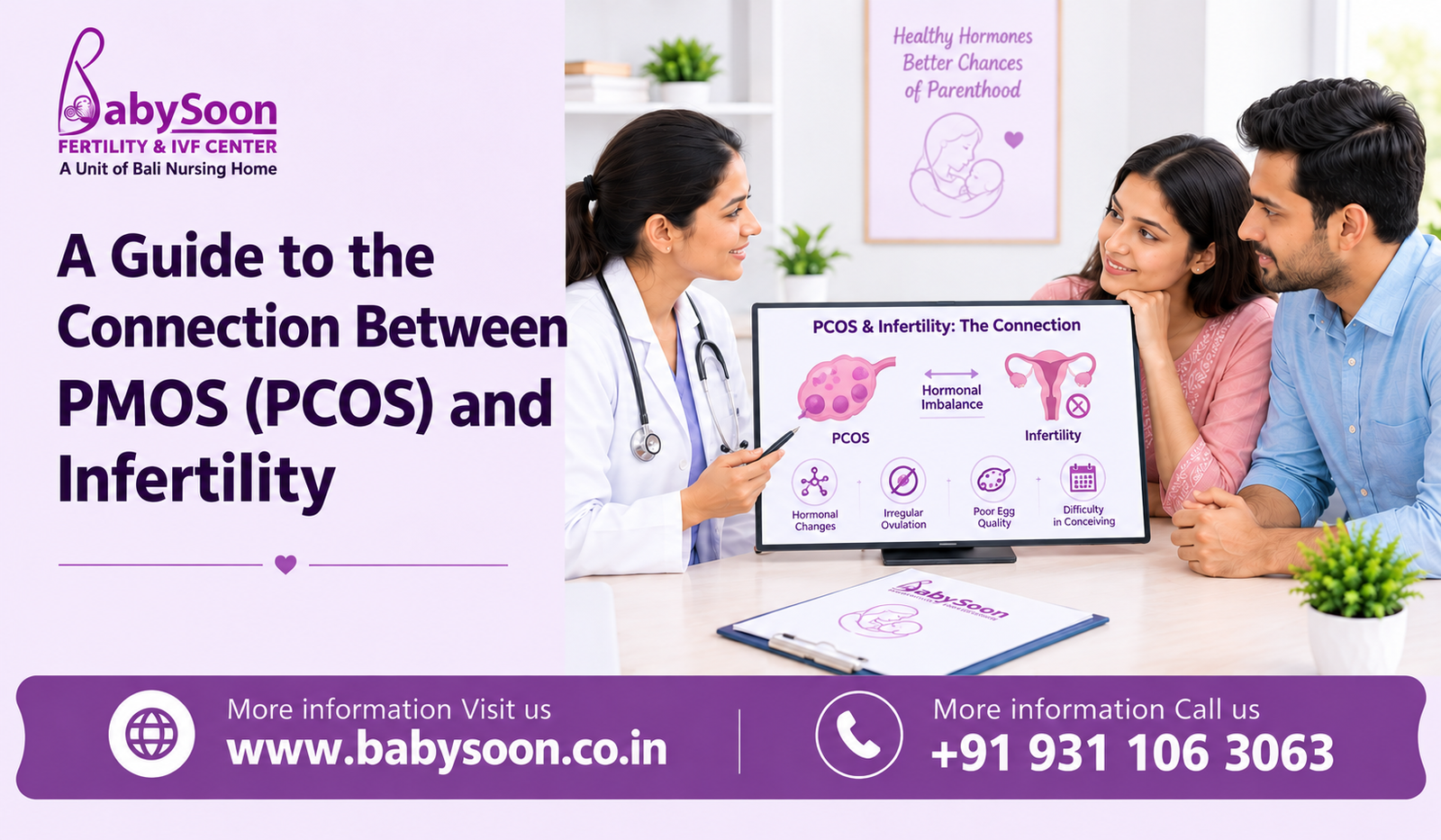
A Guide to the Connection Between PMOS (PCOS) and Infertility
A PMOS diagnosis can raise an immediate question for many women: Will this make it harder or even impossible to conceive? Polyendocrine metabolic ovarian syndrome (PMOS), formerly known as polycystic ovary syndrome (PCOS), is a complex endocrine and metabolic condition that can affect ovulation and fertility. At BabySoon IVF in Delhi, fertility care begins with understanding what is affecting ovulation and conception so that treatment can be planned according to each patient’s needs.
It is also important to understand the difference between PMOS and infertility. Infertility refers to difficulty achieving pregnancy after a defined period of regular, unprotected intercourse, while PMOS is a medical condition that can contribute to infertility, particularly when it causes irregular or absent ovulation. Having PMOS does not automatically mean that a woman is infertile.
What Is PMOS and Why Was PCOS Renamed
PMOS stands for Polyendocrine Metabolic Ovarian Syndrome, the new name for the condition previously called Polycystic Ovary Syndrome (PCOS). The name was changed in 2026 following a global consensus process because the older term did not fully describe the condition.
The word “polycystic” can be misleading because the ovarian appearance associated with the condition generally represents multiple small follicles rather than ovarian cysts. More importantly, the condition affects much more than the ovaries. Hormonal, metabolic, reproductive and other health factors can be involved.
The new name, PMOS, is intended to better reflect these wider features. The updated international guideline now uses PMOS or PMOS/PCOS terminology, while the clinical recommendations remain essentially unchanged from the previous evidence-based guideline.
For women in India, this means that an earlier diagnosis of PCOS is still relevant. PMOS and PCOS refer to the same underlying condition, so a woman does not need to undergo a new evaluation simply because the medical terminology has changed.
Can PMOS Cause Infertility
Yes. PMOS can contribute to infertility, primarily because it may cause ovulatory dysfunction or anovulation, meaning ovulation occurs irregularly or does not occur.
Hormonal changes, including elevated androgen levels and altered follicular development, can interfere with the normal maturation of ovarian follicles. As a result, menstrual cycles may become irregular and ovulation may happen infrequently or not at all.
However, not every woman with PMOS experiences infertility. Some women ovulate regularly and conceive naturally, while others may need medical assistance.
Fertility also depends on several other factors, including age, ovarian reserve, fallopian tube health, uterine factors and sperm quality. Therefore, difficulty conceiving should not automatically be attributed to PMOS without a complete fertility assessment.
How Does PMOS Affect Ovulation and Fertility
Ovulatory dysfunction is one of the main ways PMOS can affect fertility.
During a typical menstrual cycle, ovarian follicles develop, and one generally becomes dominant before releasing an egg. With PMOS, hormonal disturbances can affect follicular development and prevent regular ovulation.
Metabolic factors can also play a role. Insulin resistance is common in PMOS and can be associated with higher insulin levels. These metabolic changes may contribute to increased androgen activity and further interfere with normal ovulatory function.
The updated PMOS approach also recognises that reproductive health should not be considered separately from metabolic and general health. Assessment may therefore include factors such as blood pressure, glucose metabolism and lipid profile when clinically appropriate. This is why PMOS management should be individualised rather than based only on menstrual symptoms or an ultrasound finding.
What Are the Signs PMOS May Be Affecting Fertility
Irregular menstrual cycles are an important indication that ovulation may not be occurring consistently. Some common changes include:
- Menstrual cycles that are longer or less frequent than usual or irregular
- Periods that are absent for several months
- Unpredictable menstrual bleeding
- Difficulty identifying the fertile window
- Infertility
Other features associated with PMOS may include:
- Acne
- Excess facial or body hair growth
- Thinning of scalp hair
- Weight changes
- Features associated with insulin resistance
However, symptoms alone cannot confirm PMOS or establish whether it is responsible for difficulty conceiving.
Current evidence-based recommendations emphasise that the diagnosis of PMOS should be based on a proper clinical assessment rather than an ultrasound finding alone. In adults, the Rotterdam Criteria are commonly used for diagnosis. The Rotterdam criteria are a set of guidelines used to diagnose Polyendocrine Metabolic Ovarian Syndrome (PMOS). According to these criteria, PMOS is diagnosed when at least two of the following three features are present: oligo-ovulation or anovulation, hyperandrogenism, polycystic ovarian morphology on ultrasound. In adults, AMH may also be used as an alternative to ultrasound for assessing polycystic ovarian morphology.
If pregnancy has not occurred after regular, unprotected intercourse for one year, a fertility evaluation may include medical and menstrual history, physical assessment, hormonal investigations and pelvic ultrasound when indicated. Assessment of ovarian reserve is mandatory. Semen analysis is equally important because infertility can involve the male partner, female partner or both.
Can You Get Pregnant Naturally With PMOS
Yes. Many women with PMOS conceive naturally, while others require fertility treatment. The possibility of natural conception depends largely on whether ovulation is occurring and whether other fertility factors are present.
Lifestyle and metabolic health can also be part of PMOS care. Regular physical activity, a balanced diet and achieving or maintaining a healthy weight where medically appropriate may support metabolic and reproductive health. Importantly, PMOS management should not focus on weight alone; treatment should be individualised according to the woman’s overall health and reproductive goals. If ovulation is irregular or absent, medical ovulation induction may be recommended.
For women with PMOS-related anovulatory infertility and no other major infertility factors, letrozole is recommended as the preferred first-line medication for ovulation induction in current international evidence-based guidance. Clomiphene citrate may also be considered in selected circumstances.
Ovulation-induction treatment may be monitored using ultrasound and other assessments when clinically appropriate.
How Is PMOS-Related Infertility Treated
Treatment depends on ovulation, age, reproductive history, ovarian function and whether other fertility factors are present.
1.Ovulation induction:
For women whose main fertility problem is irregular or absent ovulation due to PMOS, ovulation induction is often the first treatment approach. Letrozole is currently recommended as the preferred first-line pharmacological option for anovulatory infertility associated with PMOS when there are no other major infertility factors.
2.IUI:
Intrauterine insemination may be considered in selected cases, depending on sperm quality, ovulation and other fertility factors. During IUI, processed sperm is placed directly into the uterus around the time of ovulation.
3.IVF:
In vitro fertilisation may be considered when other treatments have not been successful, when additional infertility factors are present, or when IVF Treatment in Delhi provides a more suitable treatment pathway.
Women undergoing IVF with PMOS may have a higher risk of ovarian hyperstimulation syndrome (OHSS). Current fertility practice therefore emphasises individualised stimulation protocols and strategies that can reduce this risk when appropriate.
A fertility specialist may also assess conditions that can coexist with PMOS or contribute to difficulty conceiving, including thyroid abnormalities and other endocrine or reproductive factors.
When Should You See a Fertility Specialist for PMOS
Very irregular or absent periods can be a reason to seek medical advice sooner because they may indicate that ovulation is not occurring regularly.
You should also consider a fertility evaluation if you have been trying to conceive without success. An assessment can help determine whether the difficulty is related to ovulatory dysfunction, fallopian tube or uterine factors, ovarian reserve, male-factor infertility or a combination of factors.
For women with known PMOS and irregular or absent ovulation, it may not be necessary to simply wait for a prolonged period before discussing fertility care. The appropriate timing depends on age, reproductive history and individual circumstances.
PMOS and Infertility: What Should You Do Next
PMOS and infertility are closely associated when the condition causes irregular or absent ovulation. However, PMOS affects fertility differently from one woman to another.
Some women with PMOS ovulate regularly and conceive without assistance, while others may require lifestyle modifications or ovulation-induction medication, IUI or IVF. A diagnosis of PMOS does not mean that pregnancy is impossible.
If you have irregular periods, signs of hormonal imbalance, concerns about ovulation or difficulty conceiving, a comprehensive fertility evaluation can help identify the factors affecting your chances of pregnancy.
At BabySoon IVF Centre in Delhi, fertility specialists can assess ovulation along with other reproductive and metabolic factors before recommending an individualised treatment plan. Understanding the underlying cause of difficulty conceiving can help you make informed decisions about the next step in your fertility journey.